Australia
July 2026
The Reserve Bank of Australia (RBA) influences monetary conditions
primarily by setting the interbank lending rate, which then shapes broader
borrowing and savings rates across the economy. Its mandate is to maintain
inflation within a 2-3% range, adjusting policy rates upward or downward as
necessary to achieve this target. The central bank emphasized that future
policy decisions will remain data-dependent as it works to bring inflation back
to target. Inflation readings continue to be a key driver shaping expectations
for Australian interest rates.
Current challenges include economic spillovers from rising geopolitical
tensions, trade fragmentation, and the growing frequency of extreme climate
events. If such shocks are expected to be persistent and raise the risk of
inflation expectations drifting higher, the central bank would be compelled to
respond with tighter policy, typically through interest rate hikes.
The RBA board has signaled its readiness to act as needed to return
inflation to target, cautioning that further tightening may be required if
oil-related price shocks lift inflation expectations higher. So far this year,
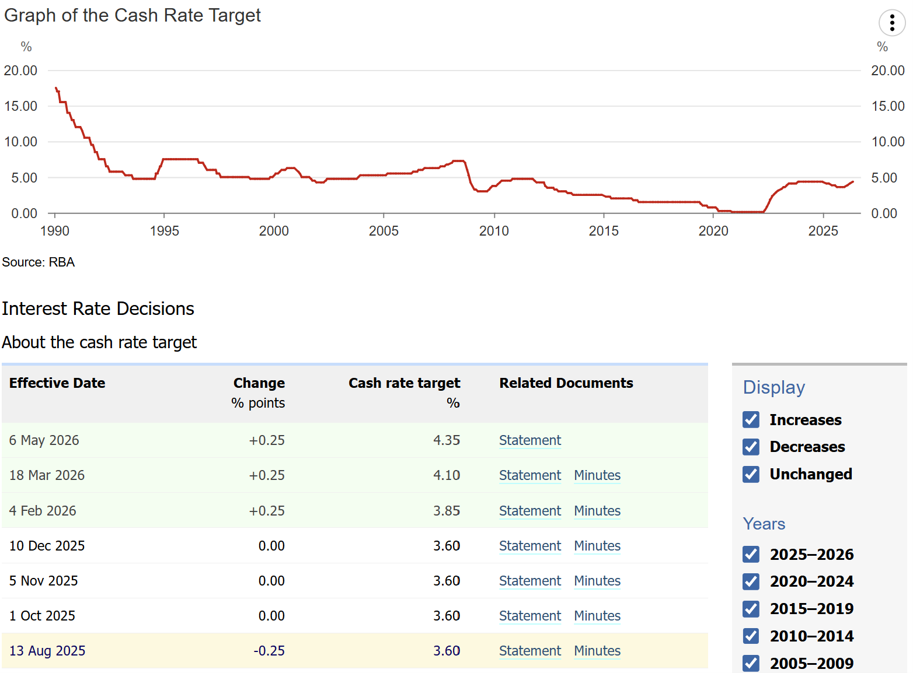
the RBA has implemented three consecutive 25-basis-point hikes, bringing the
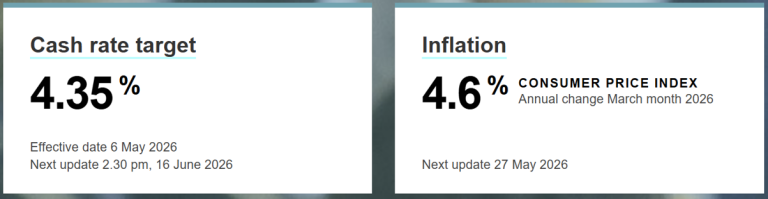
official cash rate to 4.35%. Market pricing reflected in ASX 30-day Interbank
Cash Rate Futures currently assigns a modest 19% probability of additional hike
to 4.60% at the upcoming August policy meeting.
June 2026
On 16 June, the Reserve Bank of Australia (RBA) held its cash rate steady at 4.35%, ending a run of three consecutive hikes and marking its first pause of the year. The decision was widely anticipated and unanimously supported, though the tone of the statement remained clearly cautious. The RBA stressed that inflation remains still too high and warned that further monetary tightening is possible if price pressure fails to ease.
The decision to leave interest rates unchanged was primarily driven by weaker economic activity data. Australia’s GDP grew just 0.3% quarter-on-quarter in Q1, down from 0.9% in Q4 2025, reflecting weaker household consumption. Consumers are under mounting strain from higher mortgage repayments, rising living expenses and shrinking savings buffers. However, the economic slowdown is not yet severe enough to justify a shift in policy direction. The central bank delivered a hawkish hold, emphasizing its intent to gauge the effects of prior rate hikes. Inflation remained elevated, preventing any consideration of easing, while oil and energy prices continue to pose upside risks to the inflation. Further rate increases remain on the table should price pressures persist.
Headline inflation has eased somewhat, largely due to lower energy costs, offering temporary relief from fuel-driven price pressures. However, core inflation — closely monitored by the RBA — has continued to edge higher, highlighting the persistence of underlying price pressures. The stickiness in core inflation is likely to keep policymakers cautious.
The labour market conditions have softened with unemployment rate rising to 4.5% — its highest level in several years — but remain resilient. While unemployment has risen modestly, employment and wage growth still provide enough support to sustain demand-side inflation risks. The RBA believes the labour market retains sufficient strength to absorb restrictive monetary policy without sharp deterioration.
As a result, policymakers remain alert to the risk of renewed energy shocks feeding back into headline inflation. Nevertheless, the market is not anticipating any further significant hike this year, with only limited increase in interest rates priced in.
May 2026
The Reserve Bank of Australia (RBA) raised the cash rate by 25 basis points to 4.35% from 4.1%, marking a third hike, as it remains committed to its mandate of price stability and full employment. The RBA cautioned that the ongoing conflict in the Middle East could generate second-round effects on goods and services prices more broadly. It also noted that inflation is likely to remain above its target for some time, with risks skewed to the upside.
April 2026
Sticky inflation and volatile energy market have caused most central banks to reassess their interest rate policies. Inflation expectations have shifted higher and Reserve Bank of Australia (RBA) appears to poised to raise interest rates again in the near future. RBA is more likely to prioritize anchoring inflation expectations through further monetary policy tightening.
Australian economy faces stagflation risk. The sharp rise in fuel prices due to Middle East tension is expected to feed through to the higher inflation. This can potentially weaken the economic growth weighing on household disposable incomes and squeezing business profit margins. However, RBA needs to be careful not to overtighten when the economy shows signs of contracting, with the employment falling, unemployment rate rising and financial stability concerns coming to the fore.
March 2026
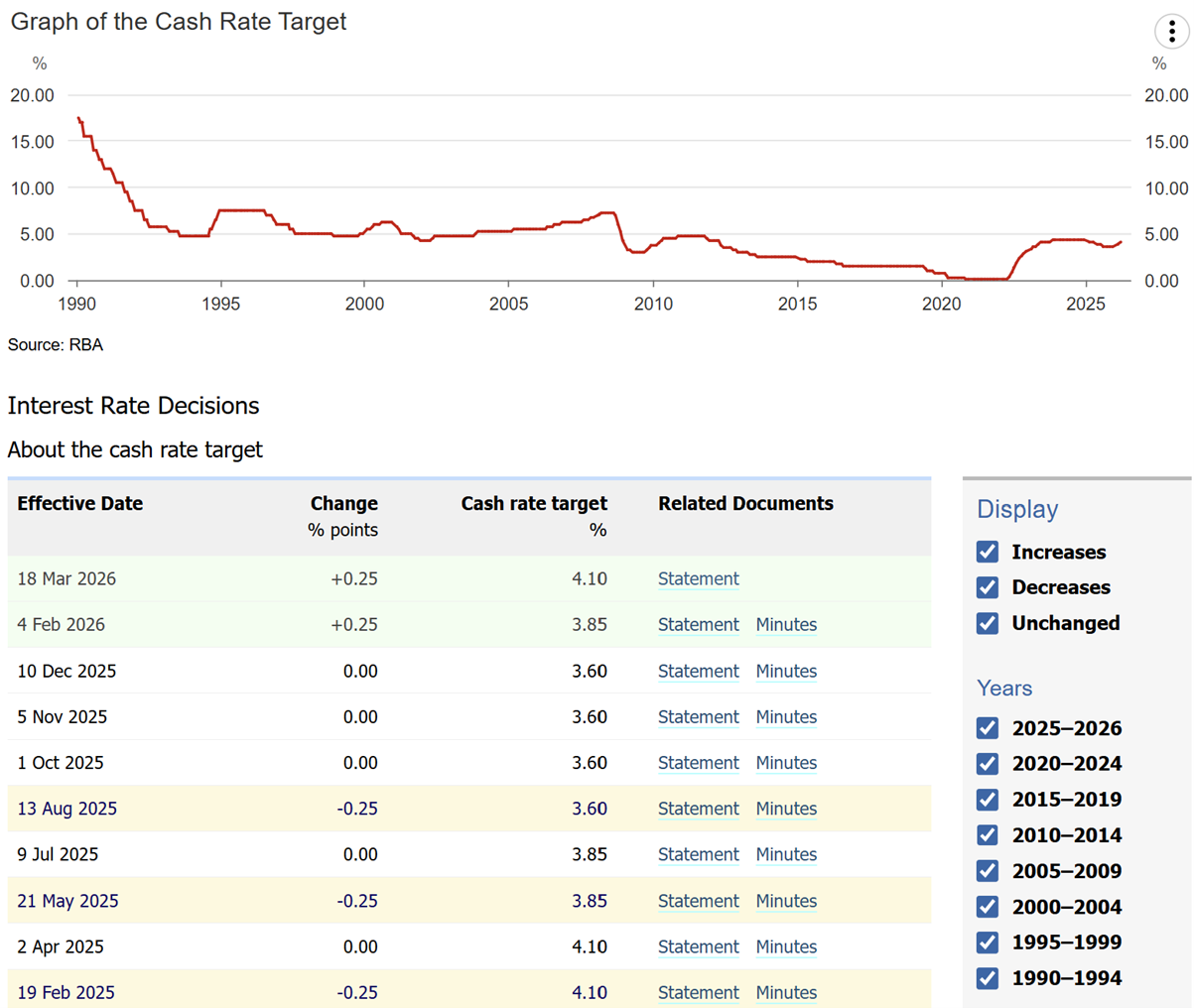
The Reserve Bank of Australia (RBA) is already of the view that the economy is operating above its potentials. RBA judges that the economy cannot grow more than 2% without generating inflationary pressures. This was the reason why it raised interest rate in February by a quarter point to 3.85% as inflation re-accelerated after the rate cuts in 2025. RBA raised cash rate again by 25bps to 4.10% in its March meeting delivering second consecutive hike as policymakers intensify efforts to contain the inflation.
Domestic economic conditions – stronger-than-expected private demand, lower-than-anticipated unemployment, a tighter labour market and demand growth outpacing supply, keeping upward pressure on prices – reinforced the view that the economy remains above its sustainable level. The central bank’s focus has shifted toward price stability, supported by the resilient labour market. Policymakers are mindful that elevated energy costs could entrench inflationary pressure if not contained. The outlook will depend on how the conflict evolves, the trajectory of energy prices, and how households respond to higher borrowing costs and rising living expenses. Although households have relatively strong savings, the combined effect of rate hikes and higher petrol prices can weigh on income growth and spending. The RBA path forward will be contingent on both domestic data and global developments.
February 2026
The Australian economy demonstrated resilience supported by a gradual recovery in private demand, stable household incomes, and robust public spending. However, the tight labor market started to show signs of softening and Australian economy’s persistent low productivity growth remains as a key challenge.
In response to the renewed price pressures, Reserve Bank of Australia (RBA) raised the official cash rate to 3.85% in February, which is the first since late 2023. RBA tries to curb persistent inflation without derailing economic growth amid labour market beginning to ease.