Real Estates as a Diversifier in the Portfolio
Real estate investments are considered an effective inflation hedge as property values and rental income tend to rise with inflation. As a tangible asset, each sub-sector offers intrinsic value with rental income.
Multi-family and Residentials: Apartments and residentials offer shorter lease terms (ex. 12 months), allowing landlords to adjust rents quickly to match the inflation.
Industrials: Industrial properties are designed for longer-term, specialized use such as manufacturing, warehousing or distribution and typical lease terms are 5 to 10 years, and they can extend up to 20 years depending on the agreement.
Commercial/Office/Hotel: Commercials cover offices and retail spaces, focusing on high visibility and accessibility. They offer usually shorter lease terms ranging from 1 to 5 years making them less restrictive. Office leases span 2 to 3 years with renewal options.
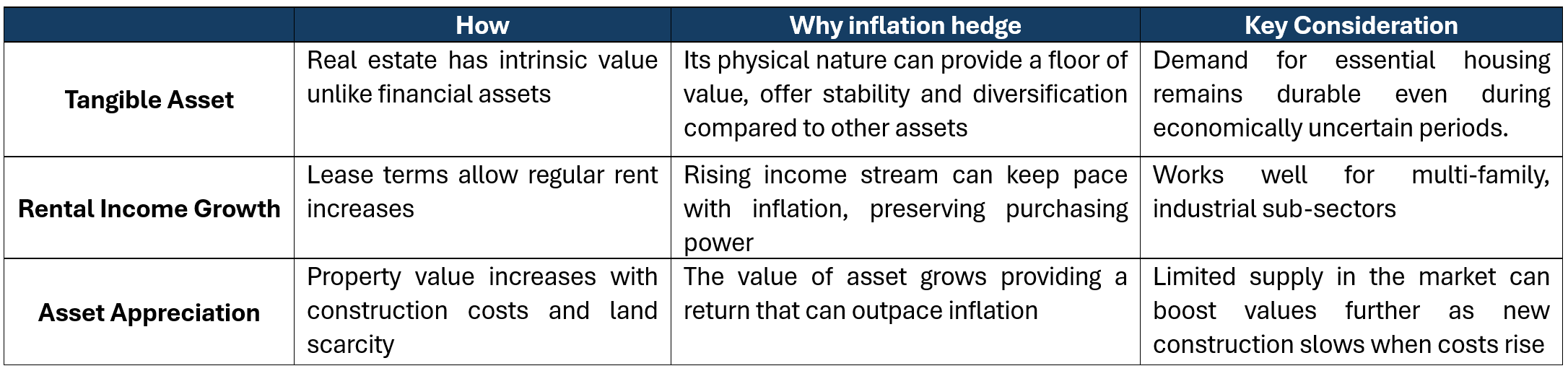
Real Estates can provide protection over long investment time horizon across various market cycles. But the way you invest matters. Direct ownership of properties can provide stable hedge even during economic crises. Investing in Real Estate Investment Trusts (REITs), however, is a passive and liquid way to invest in real estates without owning physical property or dealing with tenants. They trade like stocks so they can lose ability as a stable hedge during the market turmoil.
Before you buy properties, you should have a good idea of how you will eventually make money out of your investment. Is it monthly cash flow? Is it long-term price appreciation when you sell them? Or is it the equity you build as tenants pay down the mortgage (in case you use leverage)? The best deal will be combining all three.
What Impact Interest Rate Moves Have on Real Estates?
The Affordability and Demand: The most direct impact of interest rates on real estates is on buyers’ affordability. When interest rates rise, higher interest rates can increase financing costs. This will increase monthly payment, reducing a buyer’s purchasing power. The decrease in demand for real estates will put downward pressure on property values and sellers will need to lower prices to attract buyers. A 1% increase in interest rates can increase monthly mortgage payments as much as 10% for a 30-year loan.
Exceptions: When the rates fell in the early 1990s, real estate prices barely moved, and during the 2008 financial crisis, real estate prices plummeted in spite of falling interest rates. Broader economic factors such as unemployment can dominate the effect of changes in interest rates.
Local Economic Factors: Job growth, quality of living, taxes can play more significant roles in affordability and demand than the interest rate changes.
Price Appreciation / Depreciation (Cap Rate): Real Estate investment competes with almost risk-free investments such as US Treasuries. If Treasury yields rise, investors will demand a higher return and hence a higher cap rate from real estates to justify additional risk investors are taking. Cap rates move inversely to property values. The formula is as follows:
Property Value = Net Operating Income / Cap Rate
If interest rates fall, required cap rates will also fall, which will increase the property’s value for the income streams. Conversely, if interest rates rise, required cap rate will also rise and it will push the property value down. Real estate values can be recalibrated based on higher or lower interest rates.
Housing Supply: Interest rates can influence the supply of properties on the market. When rates spike, selling the real estates could mean taking on a new mortgage at a rate of above 6%, for example, which could increase monthly housing cost compared to previous mortgage rate of below 4%. This will reduce inventories of existing home for sale. This can create a floor for the housing prices as buyers compete for a limited number of homes. This supply effect explains why housing prices remained elevated in 2025 even though listing increased and rates stayed high. Also, markets with elastic supply where it’s easier to build new houses, will see softer price response to interest rate changes, while supply-constraint markets will see higher volatility.
The Hedge: Rate increases often occur during inflationary period. The inflation can push rents and property income higher, which helps to offset the negative impact from rate hike and it can support real estate value. This dynamic varies by sector with warehouse and multi-family properties showing more resilience than commercial and office spaces.