What Are Balance of Payment and Trade Balance?
What Is Balance of Payment?
The balance of payments (BOP) is a statistical record of all economic transactions between the residents of a country and the rest of the word during a specific period (a year or a quarter). It is also a method that countries use to monitor all international monetary transactions. There are three main categories of the BOP: current account, capital account, and financial account.
The current account marks the inflow and outflow of goods and services into a country (exports – imports). Trade in services includes intangible items such as tourism, banking, insurance and consulting fees. Also, dividends from foreign stocks, interest on foreign bonds, wages or remittance earned by residents working abroad, foreign aid and grants can all be included in the current account.
The capital account records all international capital transfers. The capital account records specialized, non-financial and non-produced asset transfers including intangible assets like patents, copyrights, trademarks, and franchise, and capital transfers such as debt forgiveness, migrants’ transfers (the value of goods and assets people bring when they move to a new country).
In the financial account, international monetary flows related to investment in businesses, real estates, financial assets such as bonds and stocks are recorded. Financial account includes financial assets and liabilities and reserve assets (foreign currency reserves held by a country’s central bank). This account acts as the balancing item. For example, if a country has a deficit in its current and capital accounts, it must be financed by selling official reserves.
Current Account + Capital Account + Financial Account = 0
BOP should be zero, with assets and liabilities balance. BOP can tell investors if a country has a deficit or a surplus from which part of the economy.
Surplus vs Deficit
Current Account Surplus: This is when a country exports more goods and services and have more income than what the country imports. The country becomes a net lender to the rest of the world. These countries include China and Germany. The country is earning more from abroad than it is spending and this surplus is offset by a deficit in the financial account. The country invests the excess money abroad in this case.
Current Account Deficit: This is when a country imports more goods, services, and income than what it exports. The country is a net borrower from the rest of the world. These countries include United States and United Kingdom. The country is spending more on foreign trade than what it is earning. The deficit should be financed by a surplus in the financial account. The country will be borrowing from abroad or selling off domestic assets.
Why Balance of Payment Matters?
Balance of payment provides a comprehensive picture of a country’s economic standing and its relation with other countries. Governments and central banks use BOP data to formulate monetary, fiscal and trade policies.
BOP also influences a country’s exchange rate. A large account deficit will put downward pressure on a currency in the long-term, while a surplus can strengthen the domestic currency. International investors take a closer look at BOP figures to assess the risk of investing in a country. A country with chronic deficits and dwindling reserves may be seen as a risky investment.
What Is Trade Balance?
Trade balance or the balance of trade refers to the difference between the value of a country’s exports and imports over a specific period. This includes both goods (physical products such as machinery, oil and food) and services (like software, tourism and banking services).
Trade surplus occurs when exports exceed imports meaning that a country sells more abroad than it imports. Trade deficit happens when imports exceed exports. The country buys more from overseas than it sells.
A trade deficit isn’t necessarily a bad thing as it can signal a booming economy with stronger domestic demand. A trade surplus can also be a bad thing as it might mean the economy is saving too much and consume too little.
The trade balance as part of current account is offset by capital account – a trade deficit is balanced by foreign capital inflows or foreign investment. Trade deficits are often caused by deep structural factors such as savings rate or fiscal policy. Government’s decision to borrow heavily due to expansionary fiscal policy such as tax cuts or increased government spending, can increase interest rates and strengthen its own currency. This will make domestic goods uncompetitive for exports and foreign goods cheaper for imports, thereby creating or widening a trade deficits.
Given Trade Deficit (Net Capital Inflow) = Investment – Savings, trade deficit is caused by a shortfall of its own national savings relative to its investment. A shortage of national savings whether from low private savings or a large government budget deficits (when the government spends more than it collects in taxes), can cause a trade deficit. Higher savings can cause a trade surplus for the country that is saving.
What Is the Trade Balance’s Impact on Currencies?
A large deficit can weaken the local currency due to higher demand for foreign goods and currencies to pay for imports. A trade surplus (ex. China and Germany) can cause foreign buyers need those currencies to pay for those goods, pushing the currency value of those countries up. Currency value of a trade deficit country (ex. United States) will get lowered conversely.
Weaker currency will make a country’s exports cheaper and more attractive globally, shrinking that country’s deficits.
Large government budget deficits can lead to higher interest rates as the country need to borrow more by issuing Treasury bonds. The country’s currency will strengthen as a result, making exports more expensive and widening the trade deficits.
What Are Twin Deficits?
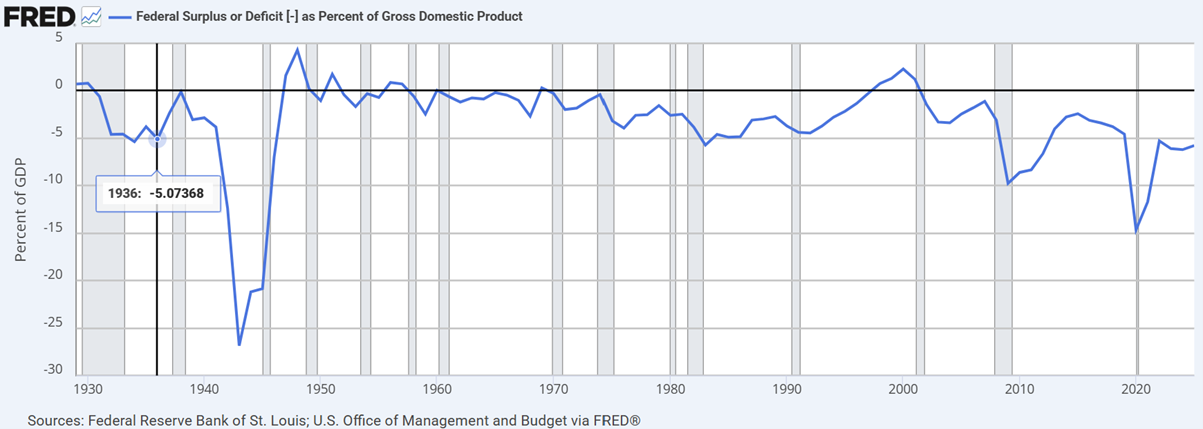
Expansionary fiscal policy such as tax cuts or increased government spending can cause twin deficits situation.
Suppose despite expansionary fiscal policy, US government does not raise taxes to pay for it. To cover the shortfall, the government needs to borrow money by issuing Treasury bonds which is effectively selling the debts to investors.
To attract lenders the government has to offer a more attractive interest rate. This will push interest rates up across the economy. Global investors such as pension funds, foreign government searching for a good return, may become attracted to these higher returns of US bonds and sell their own currencies (ex. Yen, Euros, Sterling, etc) and buy US dollars to invest in higher-yielding US assets. This will create an inflow of foreign capital to the US market.
As the demand for the USD increases, the dollar becomes stronger against other currencies. A stronger dollar means that a foreign buyer, American-made products priced in USD cost more in other currencies. Therefore, US companies’ export decrease. Imports however, become cheaper as a product made in Europe priced in Euro for example, costs fewer dollar. US consumers and businesses may buy more imports.
The Twin Deficits refer to the budget deficits from fiscal policy as well as the trade deficits – shrinking exports and swelling imports worsening trade deficits. These are linked by the chain reaction of interest rates, capital flows and the exchange rates. Government’s decision to borrow heavily can cause higher interest rates, a stronger currency making domestic goods uncompetitive than foreign goods, thereby creating or widening a trade deficit.
When this does not happen?
Monetary policy: When the central bank is lowering interest rates to fight a recession, it can counteract the fiscal policy’s effect on interest rates rising.
Global economic conditions: When the world is in a recession, or if other countries have even higher interest rates, capital may not flow into the US.
Safe Haven effect: Capital inflow into the US may not necessarily because of higher yield, but because US is seen as a safer place to invest money in during global crisis. This strengthens USD demand and widens the trade deficits but it is not due to domestic expansionary fiscal policy.