What Are Monetary Policy and Fiscal Policy?
What Do Central Banks Do?
A central bank is a financial institution that manages a country’s interest rates, money supply and a currency. Central banks deal with government and other commercial banks not the general public. While the specific goals of a central bank can vary from country to country (e.g., the Federal Reserve in the US, the European Central Bank, the Bank of England, the Bank of Japan, etc), they generally share the following core sets of responsibilities.
Monetary policy
This is the central bank’s main role. A central bank takes actions to control the money supply and credit in the economy to achieve the two primary goals – price stability and maximum employment. Price stability refers to controlling inflation and deflation. Most central banks target a low, stable and predictable rate of inflation (often at around 2%) and this protects purchasing power. Its another goal is to foster economic conditions that allow for as many people as possible to find jobs. Central banks use policy interest rates, open market operations, reserve requirement and quantitative easing to achieve these goals.
Policy interest rate: Setting a key short-term interest rate such as Federal Funds rate in the US is a central bank’s main tool. When they raise interest rates, they make borrowings more expensive for banks, which trickles down to businesses and consumers, cooling the inflation and slowing down the economy. When they lower the interest rate, it will have the opposite impact – encourage borrowing and spending to stimulate a sluggish economy.
Open market operations: This involves buying and selling government bonds in the open market. When a central bank buys bonds, it pays with money it creates, which injects cash into the banking system. When a central bank sells bonds, it removes cash from the system, directly influencing the money supply and interest rates.
Reserve requirements: This refers to a fraction of customer deposits that commercial banks are required to hold in reserve at the central bank. Lowering requirements can free up more money for the banks to lend, while raising the requirements can restrict lending.
Quantitative Easing (QE): This is less conventional tool used during economic crises such as 2008 financial crisis and 2020 pandemic. When the policy interest rates were already near zero, the central bank bought massive amounts of financial assets like government bonds and even corporate bonds to create money in the system and provided liquidity in the market encouraging lending and investments. QE was necessary in 2008 but when the emergency was over it kept going and the government’s financing costs were subsidized by the central bank. QE in 2010s has become a near permanent feature of the central bank’s power and policy.
Banker to the government
The central bank manages the government’s bank accounts, processing payments such as salaries, welfare and supplier bills and advises to the government on economic and financial matters. It also acts as an agent for the government in the financial market by managing the auction of government bonds to finance public debt.
Banker to commercial bank (Lender of last resort)
Commercial banks hold reserves at the central bank to settle payments with each other and when banks face a sudden rush of withdrawals (a bank run) in times of financial crises, the central bank can step in to lend them money. They play a role as the lender of the last resort to prevent a systemic risk and collapse of the entire financial system.
Regulate and supervise the financial system
Central banks often oversee and regulate commercial banks and other financial institutions. They set rules to ensure these institutions are financially sound and maintain stability and trust in the financial system.
Manage currency and reserves
The central bank has the sole authority to print money and manage the country’s foreign exchange and gold reserves. They may intervene in foreign exchange market to manage the value of its currency to make exports cheaper or imports more expensive.
Maintain financial stability
In addition to regulating banks, they monitor the broader financial system for potential risks such as housing bubble or excessive leverage in the market risen from excessive borrowings by corporations that can risk the entire economy. They use their regulatory power to issue public warnings in order to mitigate these systemic risks.
Most of central banks are designed to operate independent from government as when they make politically motivated decision (e.g., printing money to fund popular programs before an election) can lead to hyperinflation. This is necessary for the long-term health of the economy.
Central banks’ primary goal is not to make a profit but to serve broader public interest by maintaining economic stability. They play a critical role in ensuring that the monetary value of money is retained in the economy, the financial system remain stable and healthy, and the overall economy can grow providing jobs for the citizens.
Fed Put
It refers to the US Federal Reserve’s intervention with accommodative policies including pausing rate hikes, cutting interest rates or providing liquidity into the market to prevent severe stock market declines. The Fed intervened during market crises – the 1987 crash, the 2008 financial crisis and the 2020 Covid-19 pandemic. When the market falls drastically, the Fed will try to stabilize asset prices to boost investor confidence in the market through this mechanism.
However, it is less reliable in a high inflationary environment as the Fed will prioritize price stability over the support for the stock market. This plays as one of the core elements in today’s market psychology as it represents an expectation of rescue during a market downturn.
How Does the Central Bank Rate Decision Affect Investment?
When the central bank’s announcement turns out to be more hawkish-than-expected, it is negative for stocks and bonds as it alludes policy tightening and as a result, the US dollar will rally. Policy tightening is also negative for energy and metals. When the central bank’s announcement is more dovish relative to the expectation, stocks and bonds will rally as dovishness signals accommodative policy. It is positive for energy and metals as well but USD will be sold-off.
Why Global Bond Yields are Affected by Fed's Decisions?
Global yields are highly affected by the Federal Reserve’s monetary policy decisions mainly due to US dollar’s dominant role in the global finance system and due to the depth of US Treasury markets. When the Fed adjusts its monetary policy in the US, it does not just change rates in the US. It creates a ripple effect through to the global financial system.
Table below shows the primary mechanisms through which the Fed’s decisions transmit to global bond markets:
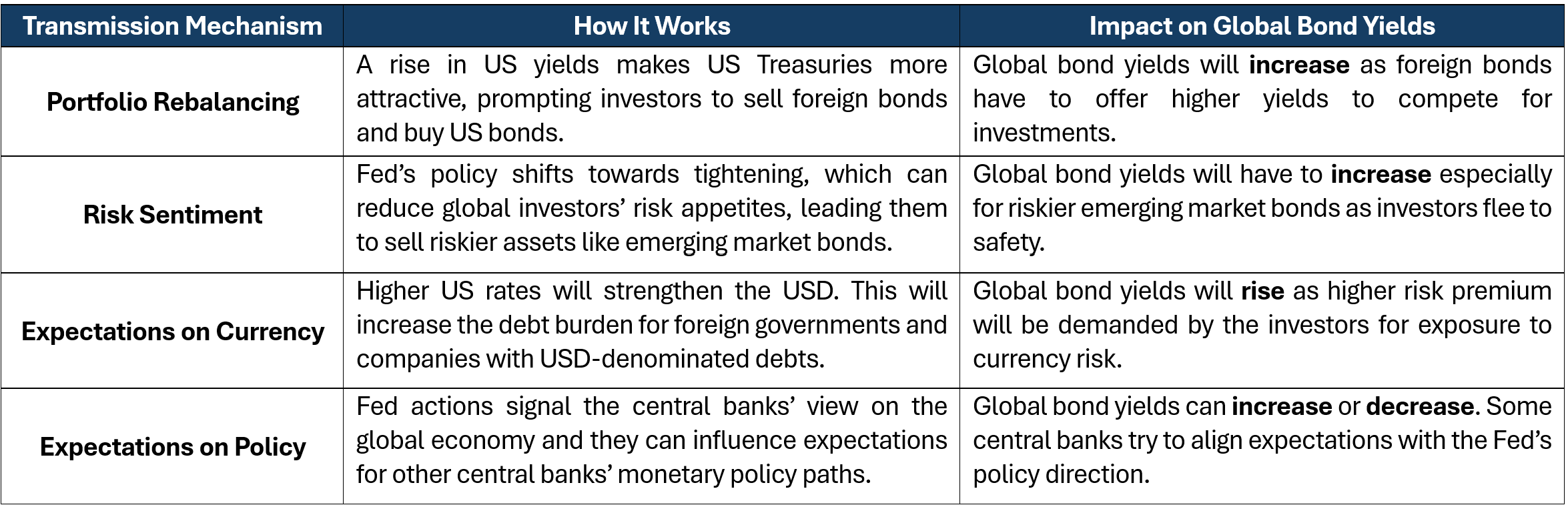
The impact of the Fed’s decision is not uniform across all countries. Bond yields in advanced economies such as UK, Germany and Japan tend to move in close sync with US Treasury yields. Their deep financial integration with the US means that Fed actions can be a primary driver of their own long-term rates.
Emerging market economies are generally more vulnerable to Fed’s tightening. It can trigger capital outflows from those countries, raise the cost of their dollar-denominated debts, pressure their currencies’ value, which will in turn push their bond yields higher. Each emerging economy’s financial structure and trade tie with the US will affect the magnitude of the impact from the Fed’s decision. Some countries like China have demonstrated relatively autonomous response to the US monetary policy due to their distinct financial structure and capital control, making their bond market less susceptible to Fed-driven moves.
What Is Fiscal Policy?
While monetary policy is managed by a central bank, fiscal policy is the government’s tool to manage the economy primarily through adjustments in taxation and government spending. Government spending can include money spent on infrastructure such as roads and bridges, public services such as defense and policy, and social programs including unemployment benefits. This spending injects money directly into the economy. Taxation is the money the government collects from individuals and businesses. This affects how much disposable income consumers can spend and how much more businesses can invest.
Depending on the economy’s conditions, fiscal policy can be used in two ways:
Expansionary policy
The government increases spending on building projects, hiring and/or cut taxes. This policy is used to fight a recession or high unemployment to boost economic growth. However, this often leads to budget deficits when the government spends more than what it collects adding to the national debts. However, expansionary fiscal policy will lift GDP of a country.
Contraction policy
The government reduces spending and/or raises taxes. This will cause consumers to have less money to spend, reducing overall demand. This policy is used to fight inflation when the economy grows too fast and prices gets out of control. The goal of this policy is to cool down the economy. But if it is done too aggressively, it can slow down economic growth leading to higher unemployment.
What Does Higher Deficit Mean for Investment?
Bigger deficit means more treasury supply and it can push up long-end yields (10 year and above) higher. The stronger fiscal impulse is broadly positive for equities. Government’s fiscal trajectory can push government yields higher while putting a downward pressure on the country’s currency. Budget deficit will require higher term premium and higher coupon issuance size, which will provide another source of volatility in the market.
Crowding-out in normal economies: When the government borrows more, it increases demand for loanable funds, pushing up the interest rates. Higher interest rate will discourage businesses from borrowing for capital expenditures, which will in turn reduce private investments.
Crowding-in in weak economies: During a recession, higher government spending (higher deficit) can boost aggregate demand, raising business confidence and it will lead to more private investment especially when the central bank is more accommodative.
Inflation and uncertainty: Persistent large deficits can raise inflation expectations or fear of future tax hikes, which can reduce long-term investments.
External balances: A higher deficits can worsen current account. A large deficit will push up interest rates, attracting foreign capital. This will cause the currency to appreciate making import cheaper and exports less competitive and as a result, current account worsens. However, worsened current account can ultimately lead to currency depreciation.