Why Bond Investing?
Bonds vs Stock Investment
If you invest in bonds, you become a lender. You can lend money to a government, a municipality, or a corporation. Those entities promise you to pay back with interests. If you invest in equities, you become a partial owner of a company. You own an equity of a corporation with a claim on its future profits and assets.
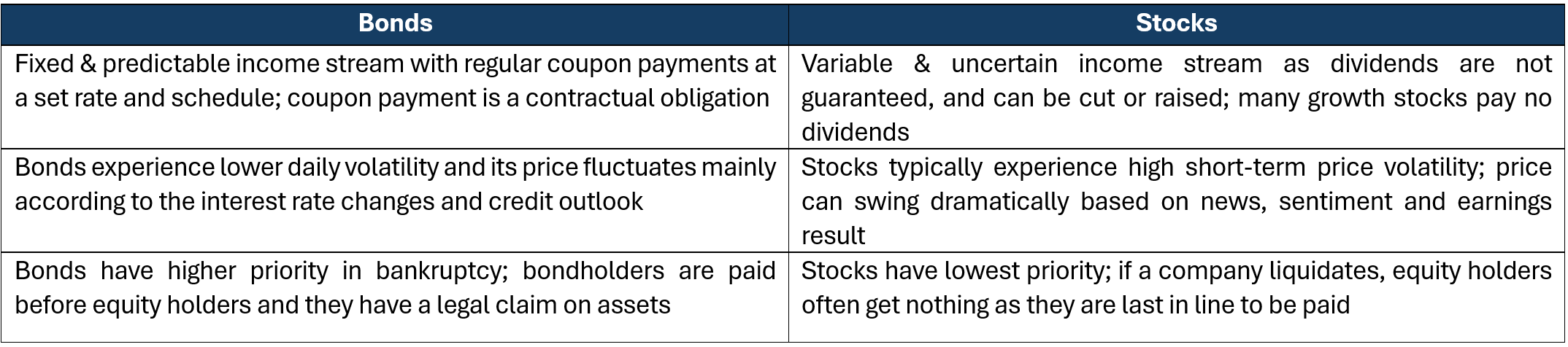
Stocks have historically provided higher average annual returns (based on S&P 500, around 10% return on average) but with greater volatility and drawdowns in the long-term. Bonds, however, provides lower but stable returns of around 4-6% on average, often performing better during economic downturns when stocks fall in value. When you can tolerate significant short-term volatility and seek growth, you can choose stocks with longer time horizon (more than 5 years is recommended). You may allocate higher portion of your portfolio to bonds, when you need reliable income, reduce overall volatility of the portfolio and have financial goals to meet in the near future.
The followings summarize the difference between bonds and stocks:
Bonds vs REITs Investment
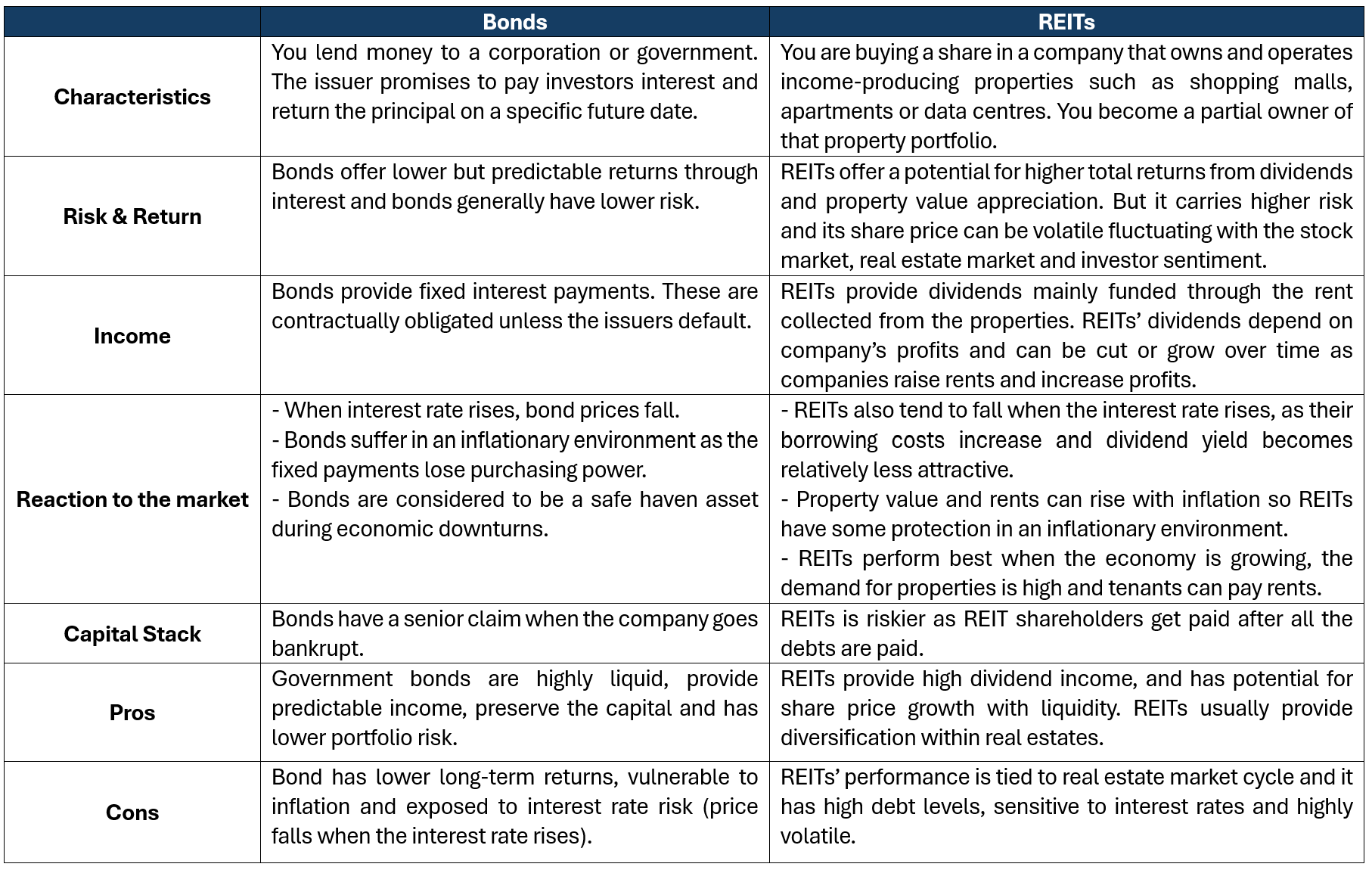
A REIT (Real Estate Investment Trust) owns, operates and finances income-producing real estates allowing investors to invest in properties. REITs pool money from investors to buy properties. By law, REITs must pay out at least 90% of their taxable income to investors as dividends. There are equity REITs that own physical properties and make money from rents, and mortgage REITs that finance real estate and earn from interests.
Comparing bonds versus REITs comes down to whether the investors want to choose stability or growth. Bonds prioritize safety and predictable income, while REITs are suitable for those who seek higher income and long-term growth despite volatility in the market.
How to choose between bonds and REITs?
Balanced portfolio may have both bonds for stability and REITs for growth and income. But if you were to choose between the two, you have to define your primary investment goals – are you focused on having steady income or achieving long-term growth?
If you are a risk-averse investors nearing retirement, you would prefer a bond as it provides stable income to cover expenses and it preserves capital. If you are an investor who seeks higher income with longer time horizon and want to have exposure to real estates without buying physical properties, REITs will be the right choice for you. However, you have to tolerate volatility in the stock market as well as real estate market to pursue higher long-term returns.
What to Consider When Investing in Bonds?
When investing in bonds, you should consider your views on the future direction of interest rates. Typically, the bond market is a good predictor of where the economy is headed. When investors buy bonds with differing maturities, for example, they can last 3 months, 2 years or 10 years, they are locking their money up for that amount of time. Investors need to have an idea of what can affect their investment during those time periods.
The Bond market is largely dominated by the US accounting for about 40%. In case of US Treasury bond and the yield curve, the primary things that can affect short-term yield is Federal Reserve’s interest rate decision. Short-term yield reacts to the Fed’s monetary policy. For example, weak jobs number can make it clear for the Fed to cut rates sooner and faster, while higher inflation can prompt the Fed to keep or raise interest rates.
When the inflation is high, investors will demand higher long-term yields. On top of inflation, Government debt issuance can affect long-term yield movement as well. If the government debt issuance gets overstretched, the government needs to pay more to bond investors in the future to borrow. Rising debt level and inflation expectations can influence financial stability and hence term premiums of the bonds – the extra higher yield investors demand for holding long-term bonds instead of investing in short-term securities over the same time period.